Subscribe Now

Monday, March 19, 2012

The Beloved Reference Shelf--On 'Relevance'

In this digital age, all one really needs is an empty room, a comfortable chair, and an internet-enabled device. What one doesn't need, strictly speaking, are shelves and shelves full of books. The first shelf to go, often, is the reference shelf, as those books are heavy and expensive and the internet is particularly excellent at providing immediate access to reference material.

Those of us who love reference books have to adjust.

Like most people, I most often treated reference volumes as books for quick consultation, taking them down off of my reference shelf as needed. But I treasured the shelves I stocked with English dictionaries and thesauri, language dictionaries in several languages, a dictionary of quotations, a rhyming dictionary, concordance, several atlases, and my much beloved New York Public Library Desk Reference, which I affectionately called the NYPLDR. (Part of an Amazon review of the book summarizes as follows):
Sections of the desk reference include music, literature, and the visual arts, religions, philosophy, and museums around the world, alphabets, grammar, and daily etiquette. Life-saving first-aid procedures are described, as are cooking tips, stain-removal advice, personal-finance details, and legal information, plus useful addresses and phone numbers relating to adoption, disabilities, and domestic violence, alcoholism, family planning, and television networks. With sections on travel, sports and games, as well as the United States and the political world, this is an irreplaceable reference of great scope and value.

I was, shall we say, something more than a casual user of reference books. I admit that I sometimes read reference books quite a lot like regular books, picking a volume of my parents' World Book Encyclopedia off the shelf and simply reading through it. My reader probably won't find it surprising that when I received an etymology dictionary as a gift, sometime in my early teens, I read it from cover to cover. The NYPLDR was similarly entertaining.

So when Farhad Manjoo callously suggested that we should celebrate the end of the Encyclopedia Britannica's print edition, I was a bit peeved. And I breathed a sigh of relief when the NYPL (of NYPLDR fame) deemed print encyclopedias 'relevant' even in the digital age. I was a little saddened that they saw the target users mainly as the old, recent immigrants, and those who couldn't snag one of the limited number of computer terminals in the library. Will there never again be a 13-year-old who says, "Hm, today seems like a good day for a read through the "D" volume"?

Etymological aside: Since it's hard for me to encounter a word without looking it up, I also serendipitously discovered an interesting irony: relevant is from the Latin 'levis' meaning 'light,' i.e. 'not heavy.' The connection becomes somewhat clear if we understand 'relevant' as 'legally sufficient,' as in a defense, which was its initial meaning. A legally sufficient defense had the ability to 'relieve' an accused of the burden of the accusation, i.e. to "lift" it or lighten his or her load. It brings a bit of levity, doesn't it, to note that 'light' is not exactly an apt description of the Encyclopedia Britannica.

Sunday, March 18, 2012

Fluke, Mutterperl, and the Politics of Jewish Male Sexuality

The revelation this week: the boyfriend of Sandra Fluke, the Georgetown law student who testified before congress about contraception and then was viciously attacked by Rush Limbaugh on radio, is Jewish. Sarah Seltzer offers an excellent post in the Forward this week about an interesting new right-wing uproar stemming from a blog post by Brooks Bayne, who suggests that the boyfriend, Adam Mutterperl, isn't only Jewish, but ultra-liberal, from a bona fide socialist family. Bayne really shouldn't get any more links to his blog, but, ok. Marc Tracy initially broke the story in Tablet, looking at Bayne's screed-like attempt to connect Jewishness ipso facto to socialism and spinning an image of a conspiracy-like web of rich socialist Jews up and down the East Coast.

Seltzer and Tracy point out some of the obvious hogwash in Bayne's argument, while noting very much correctly that the conservative concern to link Fluke to a vast lefty conspiracy has some deep-seated anti-Semitic threads at its core (or at least, that it takes very little to connect those anti-leftist sentiments to latent antisemitic sentiments when the opportunity arises). As Tracy writes, "What makes it, in the final analysis, anti-Semitic, is that Jewishness proves certain things." To tie Jewishness to modes of economic thinking that one is seeking to discredit is one of the oldest tricks in the political playbook.

But it's not just the Jews-as-socialists theme we should be calling attention to here, however, though indeed that is a long and rich trope. There is also the implicit relation to a longstanding trope of male Jews compromising the sexuality of Christian women by being at once hypersexual (i.e. having sex with unmarried women, as in this case) and insufficiently or deficiently sexual, a charge that historically has been connected to charges of Jewish male homosexuality.

It is only too fitting that the culprit in this case has among the more effeminate names that have graced members of the Jewish people: Mutterperl.

Mutterperl, a less common variant of the far more common Perlmutter, is a typical Jewish last name, meaning "mother-of-pearl." Though several Jewish last names are constructed from the first names of mothers (many names ending with -kis, -kin are matronymics: Mirkin, belonging to Mirka; Malkin, belonging to Malka), this is one of the few that actually has the word 'mother' in it. It's very feminine-ness led at least one major Hebrew writer to change it. Yehiel Perlmutter was the original name of the Hebrew poet better known as Avot Yeshurun, a name that means "Fathers of Jerusalem" (Yeshurun being one name for Jerusalem) or "Fathers are Watching us" (Yeshurun being also a form of a verb meaning "watching"). In changing his name, Avot Yeshurun changed a feminine reference to a clearly male one, as Naomi Seidman points out in her book A Marriage Made in Heaven: The Sexual Politics of Hebrew and Yiddish.

Seidman quotes an interview from the mid-1970s with Avot Yeshurun about his choice to change his name, in which he reveals that he made this change just before entering the Israeli army in a symbol of new masculinity, erasing both a feminine, Yiddish-sounding name that refers to the Diaspora past and evocations of mothers in general and his mother in particular. Her analysis, including of his memories of his own mother's lullabies, goes into further detail about this substitution.

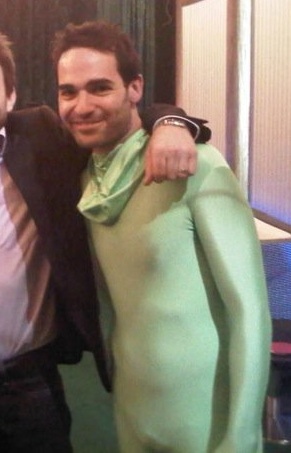
But Adam Mutterperl, name unchanged, presumably, is marked as the archetypal diaspora Jew, with his archetypical feminized name. Of course, to point out the obvious twist, it isn't the Christian right that would pick up on this irony, it is the American Jewish readership, grown up on the dysfunctional Jewish sexuality captured in Portnoy's Complaint as well as Philip Roth's continued obsession with impotence, and generally sensitive to stereotypes of effeminate Jewish maleness (especially in cases where Jewish men are dating non-Jewish women). Brooks Bayne is totally fixated on the Mutterperl family's socialism (and their wealth) in his post (rather than the son's sexuality). But the picture he posts of the guy, in a flamboyant-looking green spandex outfit, certainly suggests otherwise. In the title of the post, Bayne refers to Mutterperl as "Cutie Pants." And he implies towards the end of his rant that having liberal politics on red-blooded heterosexual sex, the kind a woman can get pregnant from and therefore needs contraception during, is really ultimately about sexual deviance. "[Fluke] ultimately has her sights set on requiring insurance to pay for gender-reassignment surgery," he claims, implying that her appeals on behalf of contraception coverage are only the beginning of a much vaster and far more deviant sexual agenda. This sort of male-bashing has been picked up by some of those who have re-posted Bayne's observations. On a right-wing forum called gold-silver.us ("a forum for gold, silver, and liberty") a poster called "General of Darkness" comments, "Maybe Adam could produce a biopic titled, “Beta Males and the Progressive Chicks Who Dig Them." Case in point: underneath the critique about leftist politics is, indeed, a critique about an imagined deviant leftist sexuality.

Much of the conservative bashing of deviant sexualities in this rendering of the Fluke story is below the surface, and I don't want to claim that even the writers themselves are aware of it. It is precisely the mix of sex and economic ideology that has made the Sandra Fluke story and the politics of contraception so compelling in the first place. To discover a Jewish man in the middle of it invites reflections—including sordid, historically loaded ones—not only about the economic deviance of Jewish men, but also about the presumption of their sexual abnormality.


(The picture of Adam Mutterperl posted on Brooks Bayne's blog)

Friday, March 16, 2012

The Thames, A River in Connecticut

Just reposting a discussion I found on Language Hat about the proper pronunciation of the Thames (and why the Thames River in CT--all 15 miles of its glorious length--is pronounced θeɪmz (that's a theta, like in "third", and the word rhymes with "James") and not like the Thames in England (rhymes with hems).
Query, Posted by Annabelle Morison at June 22, 2005 11:22 PM: One of the most interesting place names that comes to my mind when it comes to confusion of pronunciation is that of the Thames River in London, England. So far, I've heard it pronounced in three ways. Half the time, I've heard it pronounced "Tems", while other times, it was pronounced more like "Tames". But most recently I read that the original pronunciation of the name of this river is "Thaymes". Many people have told me that "Tems" is the only way that it is correctly pronounced, but I can tell you, that's definitely debatable. If "Thaymes" was the original, and thus was the correct pronunciation, how in this world did it change from "Thaymes" to "Tems"? It seems this is an unsolved mystery. Was it a British thing? Was it an American Thing? What is the story behind this confusion of pronunciation?


Reply, Posted by language hat at June 23, 2005 07:29 AM: I read that the original pronunciation of the name of this river is "Thaymes".

Your source was wrong. There was never a /th/ sound in the word; the Roman name was Tamesis, from a Celtic name also preserved in the rivers Tame and Tamar. The h was added in a fit of Renaissance pseudo-etymologizing. In England it's always /temz/.

I believe the Thames River in Connecticut is pronounced /theymz/, but that of course is simple spelling pronunciation, like /menziyz/ for Menzies and /keytlin/ for Caitlin.

So basically, just another American mispronunciation based on spelling. And there are so many.

I have to admit, sometimes I have fits of Renaissance pseudo-etymologizing. Those are really fun, but can be unpleasant for the people around me.


(The Thames River, seen from the waterfront in New London, CT--from Wikipedia)

Wednesday, March 14, 2012

On Cockneys and their English, Ahead of the 2012 Olympics


It should be easy for American visitors to London for the 2012 Olympics to get around, right? They speak English, after all. Not so fast, warns NPR's London-based correspondent, Philip Reeves.

The games themselves will be held in East London where, according to Reeves, "people speak in code." This is the land of Cockney rhyming slang, a curious linguistic contrivance developed in Victorian times by those who wanted to evade the police. Though East London is ethnically diverse nowadays, and many Cockney speakers have left (and some claims have been made that Cockney English is on its way out) the slang persists. For a compilation of examples, you can go to cockneyrhymingslang.co.uk. Some London bloggers are putting together special rhyming slang just for the games.

Now here's an interesting origin, while I've been focusing so much on birds in this blog (see my magpie post). Cockney sounds like "cock" and it is in fact related. Cockney as a noun very early on (14th, 15th centuries) meant an egg laid by a hen or "cock's egg" (I don't try to understand the problem here that cocks don't lay eggs). The "-ey" part at the end is related to the German word for egg, "Ei." A derivative meaning soon after was a child who remained too close to his mother, one who couldn't wean himself away, a mother's darling and, hence, an overly effeminate man or an effeminate townsman.

When Cockney started to be used as a term for one born within the city of London, a 17th century usage, this seemed to be because such a person was deemed inferior to other English people. 1617: "Londiners, and all within the sound of Bow-bell, are in reproch called Cocknies, and eaters of buttered tostes."

And just as so often groups get associated with their language patterns, Cockney came to refer just as much to the accent of these particular Londoners as to the population itself, though this transition didn't seem to occur until around 1900. In 1890, the English publisher Andrew White Tuer wrote of "Back-slang, or Costers' Cockney, in which the letters forming leading words are turned hindside before." Cockney speech was the supposedly inferior language that Henry Higgins tried to correct in Eliza Doolittle in Pygmalion/My Fair Lady.

So there we have the Cockney, a strange bird of its own, to be handled carefully by American visitors who might assume they know what to expect. Separated by a common language, indeed. (I highly recommend, by the way, the blog "separated by a common language," which focuses on all kinds of discrepancies between British and American English usage).

Logs, Blogs, and Chunks of Wood

A log is something you chop from a felled tree and maybe stick in a fireplace or use for construction. It is also anything shaped like said wooden object: a piece of goat cheese, for instance. A log is also a place where people record important information, for example on a ship and, nowadays, in the form of a weblog, aka. blog. What's the connection between these?

(An aside for the Talmud scholars among you: a log is also a Hebrew liquid measurement equal to about three quarters of a pint, but sometimes compared to the volume of various numbers of eggs. Rabbis in the Talmud debate just how many logs of wine one needs to drink to fulfill various ritual obligations, e.g. on Passover).

The origin of the tree log seems obscure. OED doesn't think it comes from Old Norse or Late Scandanavian though there are theories. It may have been more onomatopoeic, an attempt to express the notion of something heavy through sound, but this is inconclusive.

Here we move on to the ship connection. In the realm of seafaring, which I'm beginning to learn bits and pieces about as I blog (see my post on tenders), the LOG, between the 16th-18th centuries, was an apparatus made out of wood--basically a log--used for ascertaining the rate of a ship's motion. This contraption would consist of a thin quadrant of wood, loaded so as to float upright in the water, fastened to a line wound on a reel. 1574: "They hale in the logge or piece of wood again, and looke how many fadome the shippe hath gone in that time."

The pieces of information about distance and speed gleaned from repeated uses of the log would need to be recorded, usually on a LOG-SLATE or LOG-BOARD at first, and then later transcribed into the LOG-BOOK, which eventually got shortened into LOG.

Like so many other words, a term that had a very clear nautical context broadened in its meaning and came to mean any book in which key pieces of information were recorded. This broader sense seems not to have come into broad use until the 20th century, often as various kinds of manufacturers found themselves recording the details of their production. Thus, Printer's Ink Monthly, 1937: "Log, an account of every minute of broadcasting, all errors being considered. An accurate journal required by law." Or Fenelon, Economics of Road Transport, 1925: "A daily log prepared by the driver of each vehicle, showing the nature of the work performed, the tonnage carried, the time taken, etc."

Weblog seems to have premiered in the early 1990s to mean "A file storing a detailed record of requests handled (and sometimes also errors generated) by a web server." In 1997 the OED has the first instance of "weblog" meaning the more personal log of reflections that would eventually become the blog. J. Barger, in a Usenet newsgroup in 1997, posted the following: "I decided to start my own webpage logging the best stuff I find as I surf, on a daily basis," to which he assigned the URL www.mcs.net/~jorn/html/weblog.html.

OED has the first use of blog as both noun and verb in 1999.

By this point, it really wasn't about trees anymore, but let's not forget that this all comes from tying logs to the back of boats.

Happy Magpie Day

In honor of Pi Day, celebrated in our homophone-loving society as a holiday in celebration of pies, I thought it was appropriate to reflect on the lowly PIE.

Let's leave aside the pastry for a moment (but I'll come back to it), and note that the "pie," before it was a dessert, was a bird, the bird that we now call the MAGPIE (scientific name: pica pica). The name for this bird in classical Latin was "pica," which came into French and then English as PIE.

The word PIED was also an adjective describing the particular black and white coloring of the pie/magpie or, by extension, any multicolored plumage or clothing. Hence, the PIED PIPER of [the German town of] Hamelin who, according to folklore, led the children away from the town with his pipe after the townspeople were not willing to employ him as a ratcatcher. This story seems to date from as early as 1300.

MAGPIE was a later development of the word PIE to refer to the bird, though pie continues to be an alternative name for the bird. The magpie, it should be noted, it not exactly a much loved bird. Related to the crow, and marked by its noisy chattering call, it is also known to take an hoarde bright objects.


All together, the bird became an ill-omen. The association of women with many of these negative traits--especially its noise and its hoarding tendencies--led to the affixing of "mag" to the beginning, probably short for Maggie or Margaret, probably around 1600. The word Pica, the Latin term for pie/magpie and in reference to the magpie's feeding on miscellaneous foods, became a word used in medicine for a tendency or craving to eat substances other than normal foodstuffs, esp. non-nutritive substances, seen chiefly during childhood or pregnancy or as a symptom of dietary deficiency.

Nearly every feature of this bird became an epithet for people. The term "magpie" came to be used in reference to idle chatters in general, too. "He was so fond of talking," said one 1895 story, "that his comrades nicknamed him ‘magpie’." In the twentieth century, magpie was a nickname for hoarders, particularly collectors.

Lovers of printing and type will be interested to know that the PICA, original Latin for the pie/magpie, and now a typographical term, may also derive from the bird. The term refers to "size of type of about six lines to the inch" or about 12pt font. It may come from the fact that Pica was the nickname for a 13th century ecclesiastical book, the Sarum Ordinale which may have had a pied appearance because of the unevenly spaced blocks of text.

So what does this have to do with our ordinary pie, which are are celebrating (if obliquely) today?

Where PIE meaning "magpie" was used as early as the 1200s, PIE meaning yummy pastry seems not to have taken off until at least the 1400s. Initially, there was a link. If we recall, the magpie was known for its spotted appearance and tendency to collect lots of different things. The dish, which originally consisted of any variety of ingredients, may have been named by association with the bird, as it too was made by throwing together lots of different ingredients.

The phrase "Pie in the Sky" seems to have been coined in a 1911 poem, "The Preacher and the Slave," by labor leader Joe Hill, which was circulated in little red songbooks put together by the Industrial Workers of the World (I.W.W.--the "Wobblies"). Scorning liberal and populist promises, including those by the Salvation Army, he wrote:
You will eat, bye and bye,
In that glorious land above the sky;
Work and pray, live on hay
You'll get pie in the sky when you die.

Tuesday, March 13, 2012

Lexicon Valley Tackles Scrabble


Lexicon Valley, the new Slate podcast, speaks about Scrabble and its curious relationship to the English language. Ultimately does it celebrate language or not? Should language lovers love it or hate it?

If you don't want to listen to the full half-hour-plus episode, here is my synopsis:

Host Mike Vuolo interviews Stefan Fatsis, who wrote Wordfreak. In the interview, Fatsis comments on the nature of competitive Scrabble players, confirming that they are just not the same as us everyday Scrabble lovers. The difference: the rest of us love words and try to make high scoring ones. The competitive folks, in contrast, like math and probability. They know what letters are left in the bag; they make sacrifices in some turns to work towards 7-letter words later and make moves that eliminate the risk of opening up spaces for others. They try to memorize tons of words and stems of words that can be made into words when another letter is added: "an arsenal of language." It is ultimately a "limited use of language" oriented toward a very particular purpose.

Competitive Scrabble players build all sorts of skills. Of course the main one is rearranging letters and knowing whether there is likely to be a word contained in a particular group of letters. Some players like to learn definitions, but many don't. Fatsis himself says that he finds that it is too much for him--the goal is cramming words into one's brain and pulling them out when needed.

Lots of people hate Scrabble's reliance on super-obscure words that no one ever uses. What the game does--for the die-hards, anyway--is reduce language to a series of logical problems that can be solved by finding the optimal mathematical solution. To do so requires keeping track of what's been used already and what is yet to be played, what balance of vowels and consonants remains, and what one is likely to get on the next draw of letters.

Fatsis stresses, however, that a true word-lover can love Scrabble, too: Scrabble requires that we think of language in a way that is broader than daily usage, than active vocabulary. Perhaps it is cool that there are so many words in English that don't get used everyday. On another level, players can hope for something transcendent to happen. Something beautiful like placing whole words aligned with other words, using great or interesting words, building interesting shapes. Though technically Scrabble is all about utility, there is this beauty that can break through.

The conversation goes on to consider a great controversy about the Scrabble dictionary itself: there is a different American dictionary and international dictionary.

In 1978, the official American Scrabble dictionary 1st Ed. came out, but a different dictionary, with a broader lexicon, was being used abroad. This was in part because Hasbro owned the rights in North America, but Mattel owned them elsewhere. As Scrabble playing has grown abroad--for some reason South East Asia, and Thailand in particular, has become a hotbed for the game--the North American players who don't know the international dictionary or don't always play with it have fallen behind. Now there's pressure by some for North America to adopt the international lexicon, but others push back. Some say that it is flawed or too permissive, with too much archaism and an excess of words from Scottish and Welsh and even Maori. The controversy boils down to this: what is English? How broad is it? Does it include its full history and its full global spread? On the other hand, does an even further expanded lexicon make the game too easy? This was a critique when QI and ZA were added to the American Scrabble dictionary--now it is much less likely for one to be stuck with one of these two high-point letters. On the other hand, there have been some artificial limitations. Hasbro has also excised "offensive" terms from the dictionary, words including "jew," "jesuit," "fart," and "kike." After some protest, however, they now continue to allow those words in competition, on the basis of supplementary lists that include no definitions. For competitive players, after all, definitions are irrelevant: it's all about math and letter combinations.